
Motion Sensor Lighting for Corridors and Staircases in Dubai Buildings
Walk into almost any residential tower at 3 a.m. and you will find the same thing: every corridor and staircase fully lit, with nobody in sight. Motion sensor lighting Dubai buildings install in these spaces switches lights on when someone arrives and off, or down to a low level, once they leave.
It is one of the simplest energy upgrades a building owner, owners’ association or facility manager can make. This article explains how motion sensors work in corridors and staircases, which sensor to choose, the right time delay, and what to watch for so residents stay safe and comfortable. For the bigger picture, read our complete guide to lighting control systems in Dubai.
Why corridors and staircases are ideal for motion sensor lighting Dubai projects
Corridors and staircases have three things in common: they must be lit for safety, they are used for only a few minutes at a time, and they are empty for most of the day and night.
- Corridors on residential floors see short bursts of traffic in the morning and evening, then long quiet periods.
- Staircases in towers with lifts are used even less: mainly by maintenance staff, a few residents on low floors, and during drills or emergencies.
- Lift lobbies on each floor are busy only when residents arrive or leave.
When lights run 24 hours a day in spaces that are occupied for a fraction of that time, most of the electricity is wasted. That is why motion sensor lighting Dubai owners add to these areas often pays back faster than almost any other energy measure.
How motion sensor lighting works
The idea is simple, and non-technical owners can follow it in four steps:
- Someone enters: a resident steps out of the lift or opens the stair door.
- The sensor detects movement: a ceiling or wall sensor notices the change and sends a signal in a fraction of a second.
- Lights switch on: the fittings in that zone come on to full brightness, or the level set for that area.
- The timer runs out: after a set time with no movement, the lights dim to a low “background” level or switch off, ready for the next person.
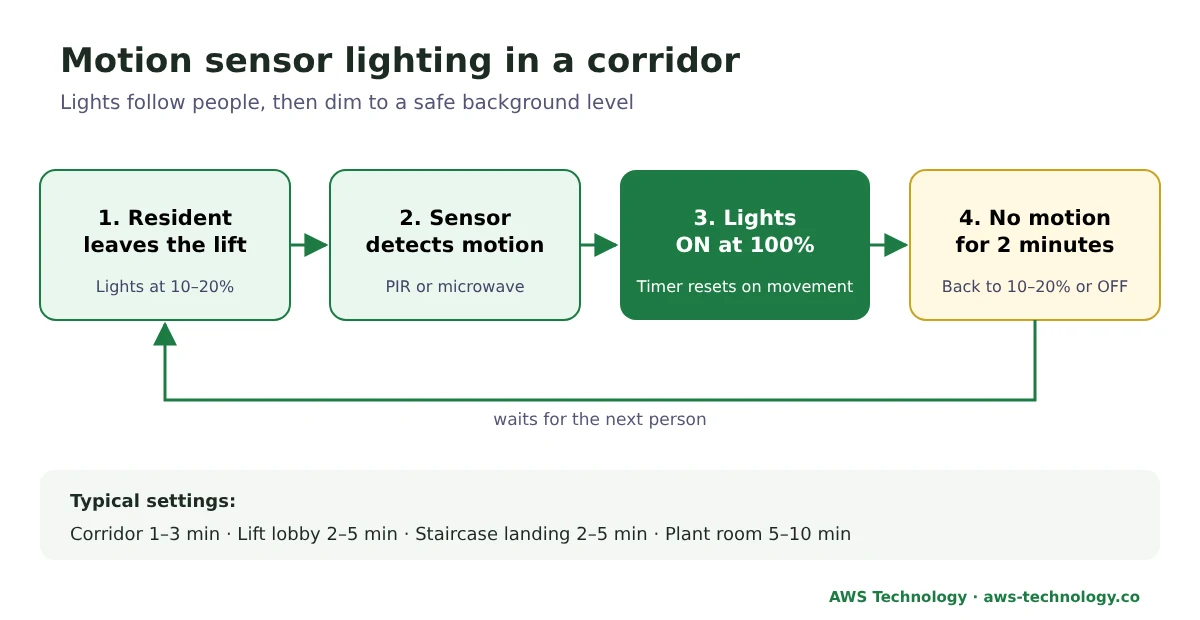
Every new movement resets the timer, so lights stay on as long as someone is moving in the space. If a lux sensor is added, the system can also keep lights off when daylight from a window is already enough (see our guide to daylight sensor lighting control).
PIR, microwave or dual-tech: choosing the right sensor
Not every sensor suits every space, and choosing the right one is the key to motion sensor lighting Dubai residents are happy with. The three main types of occupancy sensor behave differently, and the right choice prevents most complaints.
| Sensor | How it works | Best use in Dubai buildings | Limitation |
|---|---|---|---|
| PIR sensor (passive infrared) | Detects body heat moving across its field of view | Corridors, lift lobbies, short straight spaces | Needs a clear line of sight; can miss very small movements |
| Microwave sensor | Sends low-power radio waves and detects the reflection from movement | Long corridors, staircases with turns, service areas | Very sensitive; range must be set so it does not react through walls or doors |
| Dual-technology sensor | Combines PIR and microwave; usually needs both to switch on and either to stay on | Staircases and fire escapes, where lights must never switch off with someone inside | Higher cost per sensor |
As a rule of thumb, PIR sensors suit straight residential corridors, while staircases benefit from microwave or dual-technology sensors on every landing because people turn corners and may stand still.
Ceiling or wall mounting?
Ceiling sensors give 360° coverage and suit corridors with false ceilings. Wall-mounted sensors replace an existing switch, which makes them an easy retrofit for older buildings where the ceiling is hard to access.
How long should lights stay on after motion?
This is the setting that most affects both savings and comfort. Too short, and residents find themselves in the dark. Too long, and much of the saving is lost.
| Space | Typical time delay | After the delay |
|---|---|---|
| Residential corridor | 1 to 3 minutes | Dim to 10–20% or off |
| Lift lobby | 2 to 5 minutes | Dim to a low background level |
| Staircase landing | 2 to 5 minutes per landing | Dim to a low level rather than full off |
| Service corridors and plant rooms | 5 to 10 minutes | Off |
Shorter delays save more energy. In a U.S. Department of Energy demonstration in a parking garage, cutting the delay from 10 minutes to 2.5 minutes roughly halved the energy used by the new LED lights (U.S. DOE, 2013). The right setting for your building is found during commissioning and fine-tuned after a few weeks of real use.
Switch off or dim? The corridor-hold approach
Many building managers worry that motion sensor lighting in Dubai corridors will leave them completely dark and feeling unsafe. The answer is a “corridor-hold” or bi-level setting: instead of switching off, lights dim to a low level, such as 10–20%, when nobody is there.
- Residents always see a lit corridor when the lift doors open.
- CCTV cameras still get enough light to record.
- Energy use in the empty hours drops sharply, because LED power falls with the dimming level.
Dimming needs LED fittings with dimmable drivers (DALI, 0–10V or KNX-controlled). For non-dimmable fittings, a simple on/off sensor still delivers most of the savings.
Without sensors vs. with motion sensors
| Item | Lights on 24/7 | Motion sensor lighting |
|---|---|---|
| Hours at full power | 8,760 hours a year | Only while people are present |
| Common-area DEWA bill | High and fixed | Lower, depending on traffic |
| LED and driver life | Rated hours used up quickly | Lasts more calendar years |
| Maintenance calls | More replacements | Fewer replacements |
| Safety | Always lit | Lit on arrival; low background light can stay on |
| Security | No change when someone enters | Lights switching on draw attention to movement at night |
How much energy can motion sensor lighting Dubai buildings save?
Savings depend on how often each space is empty. Independent research gives useful ranges:
- In offices, occupancy sensors cut lighting energy by about 20–26% compared with manual switching (Lawrence Berkeley National Laboratory).
- In low-traffic spaces such as car parks (see our parking lighting control system guide), studies by the U.S. Department of Energy measured much larger reductions when LED lighting was combined with occupancy sensors.
Residential corridors and staircases are usually emptier than offices, so savings there tend to be higher. Because DEWA charges in slabs, buildings on the higher slabs save more for every kWh they avoid. Check the current rates on the DEWA slab tariff page.
Safety, emergency lighting and Dubai regulations
Motion sensor lighting Dubai projects must work alongside fire and life safety systems, never replace them.
- Emergency lighting stays separate: exit signs and emergency fittings remain on their own circuits and batteries as required by Dubai Civil Defence. Sensors control only the normal lighting.
- Fail-safe design: a good system switches lights on, not off, if a sensor or controller fails.
- Fire alarm interface: with KNX or DALI, the fire alarm can force all common-area lights to full brightness during an evacuation.
- Green building goals: controls help new projects meet Dubai Municipality’s Al Sa’fat green building requirements and support the UAE’s Net Zero 2050 strategy. Confirm specific requirements with your MEP consultant.
Standalone sensors or a KNX / DALI system?
Both approaches work. The right one depends on the size of the building and how much control you want.
- Standalone sensors: each sensor switches its own group of lights. Low cost and quick to install, ideal for a single building or a small number of floors.
- KNX lighting control Dubai systems: sensors from Zennio, MDT or other KNX makers share one network. Facility management can change delays and levels for every floor from one screen, and link lighting to schedules, the fire alarm and the building management system.
- DALI lighting control: each LED driver is addressed individually, so you can dim, group and monitor every fitting and receive lamp-failure reports.
AWS Technology designs both standalone and networked systems with Lutron, Zennio, MDT KNX, Bticino, Vimar and ThinKnx products. See our smart lighting control services for more.
Motion sensor lighting Dubai examples by building
Residential towers in Dubai Marina, JVC and Business Bay
Each floor’s lift lobby and corridor gets PIR sensors with a corridor-hold dim level. Staircases get dual-tech sensors on every landing. The owners’ association sees the saving directly in the common-area electricity charge.
Office buildings in Downtown and Al Garhoud
Corridors, toilets, pantries and stairwells use occupancy sensors, while open offices may combine them with daylight dimming near the windows. After working hours, schedules lower the background level further.
Villa compounds and community facilities
Gatehouses, clubhouse corridors, changing rooms and plant rooms are perfect for motion sensors because they are used in short bursts.
Common mistakes to avoid
- Too few sensors in long corridors: coverage must overlap, or the far end goes dark while someone is still walking.
- One sensor for a whole staircase: people on upper landings are not detected. Fit one per landing.
- Delays that are too short: start with 2 to 3 minutes and adjust, rather than starting at 30 seconds.
- Sensors facing lift doors or glass: they can trigger every time the lift opens or sunlight changes.
- No handover training: the facility management team must know how to change settings.
Retrofitting motion sensor lighting Dubai towers already have
Most buildings in Dubai were handed over with corridor lights wired to a simple time switch or left on permanently. The good news is that motion sensor lighting Dubai owners add to an existing building rarely needs major works.
- Ceiling sensors in existing openings: many sensors fit the same cut-out as a downlight or into an access panel in the false ceiling.
- Switch-replacement sensors: in service corridors and stairwells, a wall sensor can replace the existing switch on the same wiring.
- Wireless options: where cables are hard to run, wireless sensors talk to a receiver at the lighting circuit, reducing ceiling work.
- Driver checks: if you want dimming rather than on/off control, the survey confirms whether existing LED drivers are dimmable or need replacing.
Work is normally done floor by floor during the day, with each corridor tested before moving on, so residents and tenants see very little disruption.
Maintaining motion sensor lighting after handover
A well-installed system needs little attention, but a few simple checks keep motion sensor lighting Dubai buildings rely on working at its best:
- Review settings after the first month: traffic patterns become clear, and delays or dim levels can be adjusted.
- Keep sensor lenses clean: dust and paint overspray reduce detection range, especially after fit-out or repainting work.
- Check after layout changes: new partitions, signage or furniture can block a sensor’s view.
- Log complaints by location: if residents report lights switching off, the log shows which sensor needs adjusting.
- Use system reports: KNX and DALI systems can show running hours and failed fittings, helping facility management plan maintenance.
With these checks, motion sensor lighting Dubai residents barely notice keeps saving energy year after year.
Quick checklist for facility managers
Before you approve a motion sensor lighting Dubai proposal for your building, make sure it answers these points:
- Coverage drawing: every corridor, lift lobby and stair landing shows a sensor and its detection area, with no gaps.
- Settings schedule: a table of time delays and dim levels for each zone, agreed with you before installation.
- Driver and fitting list: which LED fittings will dim, which will switch, and which drivers need replacing.
- Safety interfaces: how the system responds to a fire alarm, and confirmation that emergency lighting is untouched.
- Savings estimate: a realistic range for each area, based on your building’s actual traffic rather than a single headline figure.
- Support plan: who adjusts settings after handover, and how quickly they respond in Dubai.
A clear proposal like this protects owners and residents, and it makes the benefits of motion sensor lighting Dubai owners’ associations approve easy to explain at the next general assembly. If you are comparing quotations, ask each contractor for the same documents so you can compare like with like.
For larger portfolios, the same checklist can be applied building by building, so a facility management company can roll out motion sensor lighting Dubai-wide with consistent settings, reports and support.
How to upgrade your building
- Free site survey: we count fittings, check wiring and drivers, and note how each space is used.
- Savings estimate: a realistic forecast for each corridor and staircase.
- 2D/3D design proposal: sensor positions, zones, time delays and dim levels, shown before any work starts.
- Installation: floor by floor, usually without closing the building.
- Commissioning and fine-tuning: settings adjusted after a few weeks of real use, with training for your team.
Why choose AWS Technology
- Design, installation and after-sales support in Dubai from our Al Garhoud office, covering Dubai and the wider UAE.
- KNX and Lutron expertise for networked lighting control in towers and villas.
- Trusted brands: Lutron, Zennio, MDT KNX, Bticino and Vimar.
- A 2D/3D design proposal before execution, so you see exactly what will be installed.
- Proven work: see our smart home and building automation projects.
Frequently asked questions
Do motion sensors really save electricity?
Yes. In offices, occupancy sensors cut lighting energy by about 20–26% compared with manual switching, and savings are usually higher in corridors and staircases that are empty most of the day. Your actual saving depends on how often each space is used.
How long should corridor lights stay on after motion?
Most residential corridors work well with 1 to 3 minutes, lift lobbies and staircase landings with 2 to 5 minutes. Many buildings dim to 10–20% instead of switching fully off, so corridors never go completely dark.
Will the lights go off while someone is in the stairwell?
Not if the system is designed well. A dual-technology sensor on every landing and a sensible time delay keep the lights on while people move, and a low background level can stay on at all times.
Can motion sensors work with my existing LED lights?
Yes. Any LED fitting can be switched on and off by a sensor. To dim to a low background level instead, the LED drivers must be dimmable (DALI, 0–10V or KNX); a site survey confirms this.
Do motion sensors affect emergency lighting?
No. Emergency and exit lighting stays on its own circuits and batteries as required by Dubai Civil Defence. Sensors control only the normal common-area lighting.
How much does motion sensor lighting Dubai buildings need cost?
Cost depends on the number of corridors and staircases, the sensor type, whether dimming is needed and whether sensors connect to a KNX or DALI system. AWS Technology offers a free site survey and an accurate quotation.
Conclusion: is motion sensor lighting Dubai’s easiest energy win?
For most towers and commercial buildings, yes. Motion sensor lighting Dubai owners add to corridors and staircases cuts wasted hours, lowers the DEWA bill and extends LED life, while dimming and good sensor placement keep every space safe and welcoming. Combined with lux sensors and a central platform such as KNX, the savings grow further. Learn more in our lighting control system Dubai guide.
Book a free site survey and energy-saving assessment with AWS Technology. Contact us here or call or WhatsApp +971 50 140 7753.