
Daylight Harvesting in Dubai: How Lux Sensors Cut Lighting Costs
Dubai has some of the strongest, most reliable sunshine of any major city, yet many lobbies, podium walkways and glass-fronted offices keep their lights at full power all day. Daylight sensor lighting control, also called daylight harvesting, fixes this. A small lux sensor measures how much natural light is already in a space and keeps electric lights off or dimmed until they are really needed.
This guide explains how daylight sensor lighting control works, where it saves the most in Dubai buildings, how it combines with motion sensors, and what owners, developers and facility managers should look for. For the wider picture of common-area lighting, read our complete guide to lighting control systems in Dubai.
What is daylight harvesting?
Daylight harvesting means using free natural light to replace part of the electric lighting in a building. Instead of lights running at 100% whenever a space is open, the system adds only the amount of electric light needed to reach the target light level.
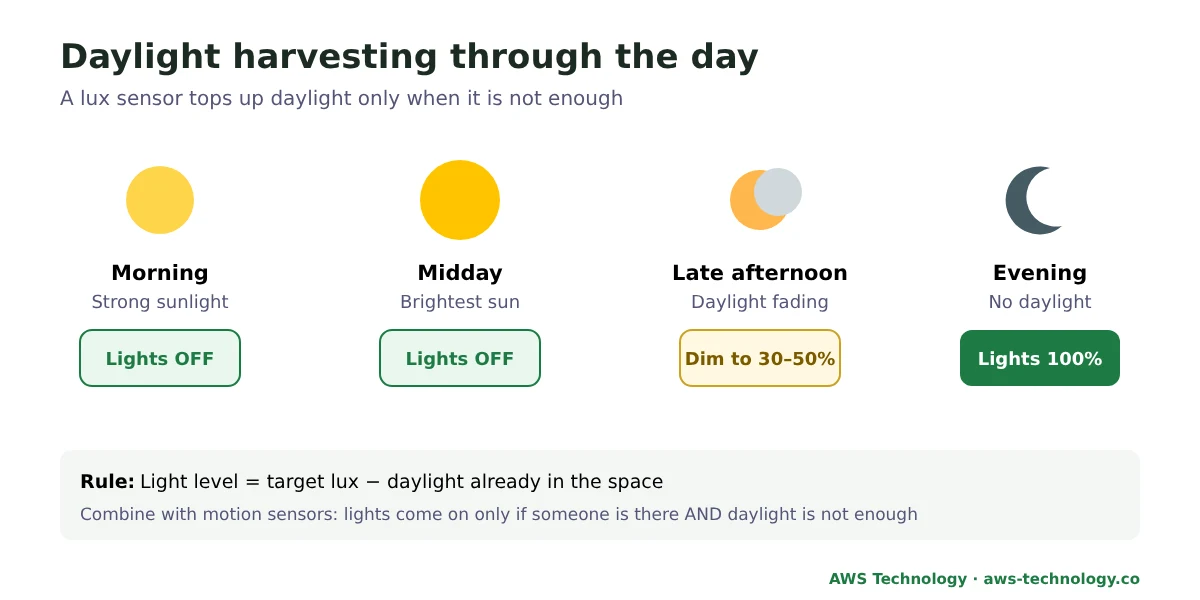
- Bright morning or afternoon: daylight alone is enough, so the lights stay off.
- Cloudy period or late afternoon: lights dim up gently to top up the daylight.
- Evening and night: daylight is gone, so lights return to their normal level, or follow motion sensors and schedules.
The device that makes this possible is a lux sensor (or photocell). It measures light level in lux and sends that reading to a controller, which adjusts the lights automatically. That is the heart of every daylight sensor lighting control system.
How daylight sensor lighting control works
Non-technical owners can follow the logic in four steps:
- Measure: a ceiling or wall-mounted lux sensor reads the light level in the space every few seconds.
- Compare: the controller compares that reading with the target level, for example the brightness agreed for a lobby or corridor.
- Adjust: if daylight is enough, the lights stay off or at a low level. If not, the lights dim up just enough to reach the target.
- Repeat: as the sun moves or clouds pass, the system keeps adjusting smoothly, so occupants barely notice.
Switching vs. dimming
There are two main ways a daylight sensor lighting control system can respond:
- On/off switching: lights switch off above a set lux level and back on below it. Simple and low cost, ideal for outdoor and semi-open areas.
- Continuous dimming: lights dim smoothly between 0% and 100% to match daylight. More comfortable for lobbies and offices, and it needs dimmable LED drivers (DALI, 0–10V or KNX).
Why daylight harvesting works so well in Dubai
Daylight sensor lighting control depends on one thing: reliable daylight. Dubai has it in abundance.
- Strong sunshine most of the year: clear skies are the norm, so daylight is available for long hours every day.
- Glass-heavy architecture: towers in Business Bay, Downtown and Dubai Marina often have full-height glazing in lobbies and lift areas.
- Semi-open spaces: podium walkways, entrance canopies and car park ramps receive plenty of natural light.
- Long operating hours: commercial lobbies and common areas are lit for many hours, so every hour of daylight replacement adds up.
Because DEWA bills electricity in slabs, buildings on the higher slabs save more for every kWh they avoid. Check the current rates on the DEWA slab tariff page.
How much can daylight sensor lighting control save?
Savings depend on window size, orientation, shading and how deep the space is. Independent research gives realistic ranges.
- In a field study of private offices by Lawrence Berkeley National Laboratory, occupancy sensors alone saved 20–26% of lighting energy, and adding daylight dimming raised total savings to 46%.
- Spaces close to large windows save the most; zones far from glass save little, which is why good design matters.
We do not quote a single headline figure for every building. A site survey shows which zones receive enough daylight to make daylight sensor lighting control worthwhile.
Without lux sensors vs. with daylight harvesting
| Item | Lights at fixed level all day | Daylight sensor lighting control |
|---|---|---|
| Daytime lighting in sunny areas | 100% even in bright sun | Off or dimmed when daylight is enough |
| DEWA bill | Higher, fixed by opening hours | Lower, depending on daylight and window design |
| Comfort | Over-lit near windows, glare | Balanced light level across the day |
| LED and driver life | Full burning hours | Fewer hours at full output |
| Heat from lighting | Full heat load from fittings | Less heat when lights are dimmed or off |
| Green building goals | Harder to meet | Supports Al Sa’fat and Net Zero targets |
Where to use daylight sensor lighting control in Dubai buildings
Lobbies and reception areas
Double-height lobbies with glass façades are the best candidates. Lux sensors keep general lighting off for much of the day, while feature lighting can follow a separate schedule for appearance.
Corridors and lift lobbies with windows
End-of-corridor windows and glazed lift lobbies can run with lights dimmed during the day. Combined with motion sensor lighting for corridors and staircases, lights come on only when it is both dark enough and someone is there.
Staircases with windows
Many towers have stair cores on the façade. A lux sensor on each landing can hold lights low during the day, while emergency lighting stays independent.
Podium walkways, entrances and car park ramps
Semi-open areas receive strong daylight. Photocells switch lights off in daylight and on at dusk, often combined with astronomical time clocks. For car parks, see our parking lighting control system guide.
Offices and workplaces
Perimeter zones near windows in offices in Downtown, DIFC or Al Garhoud can dim automatically, while inner zones run normally. This is one of the most common uses of daylight sensor lighting control in commercial buildings.
Combining lux sensors with motion sensors
Daylight harvesting and occupancy sensing solve different problems, and together they deliver the best result:
- Motion sensors save energy when a space is empty.
- Lux sensors save energy when a space is occupied but already bright.
Many modern sensors combine both functions in one device. In a corridor or lobby, the rule becomes simple: lights come on only if someone is present and daylight is not enough. Our lighting control system Dubai guide explains how the two work together across a building.
Designing daylight sensor lighting control the right way
Good results come from good design. The most important points are:
- Daylight zones: group fittings by distance from the window, so the row nearest the glass dims first.
- Sensor position: place sensors where they see the work area or floor, not direct sunlight or reflections from glass.
- Target level: agree the target lux level for each space with the owner or consultant.
- Fade rate: set slow dimming changes so occupants do not notice lights moving up and down.
- Blinds and shading: where motorised blinds exist, link them to lighting so glare control and daylight work together.
KNX, DALI or standalone?
- Standalone photocells and lux sensors are simple and affordable for outdoor areas, walkways and small lobbies.
- KNX lighting control Dubai systems link lux sensors, motion sensors, blinds and schedules on one network, using products from Zennio, MDT and other KNX makers.
- DALI lighting control dims each LED driver individually, ideal for daylight zones and reporting.
AWS Technology designs all three, using Lutron, Zennio, MDT KNX, Bticino and Vimar. Learn more about our smart lighting control services in Dubai.
Dubai regulations and green building goals
Daylight sensor lighting control supports both local regulations and national goals:
- Al Sa’fat (Dubai Green Building System): Dubai Municipality’s rating system sets energy-efficiency requirements for buildings. Lighting controls help projects meet its energy targets. Check the current edition on the Dubai Municipality building publications page and confirm details with your MEP consultant.
- UAE Net Zero 2050: using free daylight instead of electricity is one of the simplest ways for existing buildings to cut energy and emissions.
Daylight sensor lighting control and cooling in Dubai’s climate
In Dubai, lighting and cooling are linked. Every watt used by a light fitting ends up as heat inside the building, and that heat must be removed by the air-conditioning system. When daylight sensor lighting control keeps lights off or dimmed during the day, there is less heat from fittings for the AC to remove.
The effect varies with the building and its cooling system, so we do not put a number on it. But for owners and facility managers, it is a useful extra benefit: daylight harvesting reduces the lighting bill directly and can ease the cooling load indirectly, especially in large, glazed lobbies that are lit and cooled for long hours.
Good design also manages glare and solar heat. Where motorised blinds or shading exist, a KNX system can coordinate them with daylight sensor lighting control, so blinds cut harsh direct sun while lux sensors keep using the softer daylight that still enters the space.
Commissioning checklist for daylight harvesting
Daylight systems must be set up on site. A proper commissioning visit should cover:
- Target levels agreed: the lux level for each lobby, corridor or office zone is confirmed with the owner or consultant.
- Sensor calibration: each lux sensor is calibrated with a hand-held light meter at the work area or floor.
- Testing at different times: the system is checked in bright sun, in the late afternoon and after dark.
- Fade times set: dimming changes are slow enough to go unnoticed by occupants.
- Override options: facility management can raise light levels temporarily for events or cleaning.
- Handover document: a list of zones, sensors, target levels and settings is given to the building team.
A daylight sensor lighting control system that is calibrated carefully at handover keeps working well for years with only occasional checks.
Measuring the results
To prove the value of daylight sensor lighting control, compare like with like:
- Record lighting or common-area consumption for a few months before the upgrade.
- Compare the same months after the upgrade, since daylight and occupancy change through the year.
- With KNX or DALI, review logs showing how long each daylight zone runs at full output.
- Adjust target levels or zones if some areas never dim, which may mean the sensor is poorly placed.
Sharing these results with owners, tenants or the owners’ association shows that daylight sensor lighting control is delivering real savings, not just promises.
Common mistakes to avoid
- Sensor facing the window: it reads the bright sky, not the space, and keeps lights off when the room is actually dim.
- One sensor for a deep space: the back of the room may be dark while the front is bright. Use daylight zones.
- Fast dimming: lights jumping up and down every time a cloud passes annoy occupants. Use slow fade rates.
- Non-dimmable drivers in lobbies: switching on and off in occupied spaces is distracting. Use dimmable LEDs where people stay.
- No calibration: lux levels must be set on site after installation, not just left at factory settings.
Retrofitting daylight sensor lighting control in an existing building
Most Dubai buildings can add daylight harvesting without major works:
- Add lux sensors to existing ceiling grids or walls near glazed areas.
- Replace non-dimmable drivers in daylight zones where continuous dimming is needed.
- Use wireless sensors where running new cables is difficult.
- Calibrate each zone on site at different times of day.
How to get started
- Free site survey: we identify glazed areas, measure daylight and check fittings and drivers.
- Daylight and savings assessment: a realistic estimate for each zone.
- 2D/3D design proposal: sensor positions, daylight zones and target levels, shown before work starts.
- Installation and calibration: lux levels set on site and tested through the day.
- Fine-tuning and support: settings reviewed after a few weeks of real use.
Why choose AWS Technology
- Design, installation and after-sales support in Dubai from our Al Garhoud office, covering Dubai and the wider UAE.
- KNX and Lutron expertise for networked lighting, blinds and daylight control.
- Trusted brands: Lutron, Zennio, MDT KNX, Bticino and Vimar.
- A 2D/3D design proposal before execution, so you see every sensor and zone in advance.
- Real projects: browse our smart home and building automation projects.
Frequently asked questions
Can lux sensors work with LED lights?
Yes. LED fittings with dimmable drivers (DALI, 0–10V or KNX) dim smoothly with lux sensors. Non-dimmable LEDs can still be switched off when daylight is enough, which suits outdoor and semi-open areas.
What is daylight harvesting?
Daylight harvesting uses a lux sensor to measure natural light and keeps electric lights off or dimmed when daylight is enough. Lights only top up the daylight to reach the target level.
How much energy can daylight sensor lighting control save?
It depends on window size, orientation and shading. In a Lawrence Berkeley National Laboratory office study, combining daylight dimming with occupancy sensors saved 46% of lighting energy. Spaces near large windows save the most.
Where should a lux sensor be installed?
Where it can see the floor or work area of the space, not the window or direct sunlight. In deep spaces, several daylight zones and sensors are used so the area near the glass dims first.
Does daylight harvesting work with motion sensors?
Yes, and the combination works best: motion sensors save energy when a space is empty, and lux sensors save energy when it is occupied but already bright. Many sensors do both in one device.
Is daylight sensor lighting control worth it in Dubai?
For glazed lobbies, corridors with windows, podium walkways and office perimeters, usually yes, because Dubai has strong sunshine most of the year. A site survey identifies which zones will save the most.
Conclusion: why daylight sensor lighting control makes sense in Dubai
In a city with sunshine as strong as Dubai’s, paying to light sunny lobbies and walkways is wasted money. Daylight sensor lighting control uses lux sensors to keep lights off or dimmed whenever daylight is enough, cutting DEWA bills, reducing heat from fittings and extending LED life. Combined with motion sensors and a good design, it is one of the smartest upgrades a building owner can make.
Book a free site survey and energy-saving assessment with AWS Technology. Contact us here or call or WhatsApp +971 50 140 7753.