
Smart Car Park Lighting Control: Cutting Parking Energy Costs with Occupancy Sensors
Basement and podium car parks are among the most expensive spaces to light in any Dubai building. The lights run day and night, yet most bays sit empty for hours. A parking lighting control system uses occupancy sensors to keep car parks bright when cars and people are moving, and dims them automatically when the aisles are empty.
This guide explains how a parking lighting control system works, what savings real projects have measured, how to keep the car park safe, and what building owners, developers and facility managers in Dubai should ask for. It is part of our series on common-area lighting; start with the complete guide to lighting control systems in Dubai for the full picture.
Why car parks waste so much lighting energy
Car parks combine three things that drive up energy use, and a parking lighting control system addresses all of them:
- Long operating hours: most basement car parks have no daylight, so lighting runs 24 hours a day, 8,760 hours a year.
- Many fittings: a large residential or office car park can have hundreds of LED battens or high-bay fittings.
- Low occupancy: outside the morning and evening peaks, aisles may see only a few cars an hour, and at night almost none.
Every hour that full lighting runs over an empty aisle is energy paid for and wasted. That is why a parking lighting control system is often one of the fastest-payback upgrades in a building.
How a parking lighting control system works
The principle is simple enough for any owner or owners’ association to follow:
- Low standby level: when nobody is present, fittings in each zone run at a low “standby” level, often 10–30% of full output, so the car park is never dark.
- Detection: when a car enters an aisle or a person walks from the lift lobby, a sensor in that zone detects the movement.
- Full light where needed: the fittings in that zone, and usually the next zone ahead, rise to full brightness within a second.
- Hold and return: after a set time with no further movement, the zone returns to the standby level.
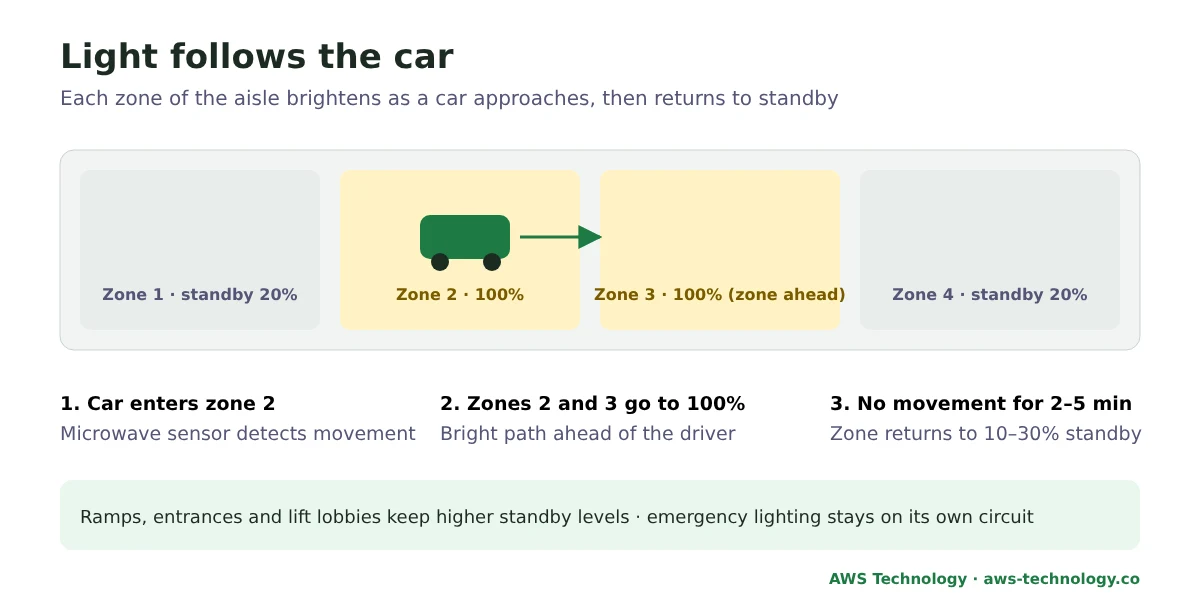
Because light follows the driver along the aisle, drivers and pedestrians always see a bright path ahead, while the rest of the car park saves energy.
Choosing sensors for a parking lighting control system
Car parks are large, open spaces with columns, ramps and moving vehicles, so sensor choice matters.
| Option | How it works | Good for | Notes |
|---|---|---|---|
| Microwave sensor | Detects movement by reflected radio waves | Long driving aisles, ramps, areas with columns | Long range; set sensitivity so it ignores movement on the floor above or below |
| PIR sensor | Detects body heat moving across zones | Lift lobbies, pedestrian walkways, stair doors | Shorter range; good for people, less reliable for distant cars |
| Sensor built into the fitting | Each LED batten has its own sensor and dims itself | Retrofits with simple wiring | Easy to install; groups of fittings can share signals on some systems |
| Networked sensors (KNX or DALI) | Sensors report to a central controller that manages zones | Large car parks, multiple levels, buildings wanting reports | Settings changed centrally; links to fire alarm and BMS |
In a typical parking lighting control system, microwave sensors cover the driving aisles and PIR sensors cover lift lobbies and pedestrian doors.
What savings do real car park projects show?
Independent field studies give a realistic picture of what a parking lighting control system can achieve. We quote them as published and do not claim they apply to every building.
- Underground office garage, Washington, DC: in a U.S. Department of Energy demonstration, replacing old high-pressure sodium lamps with LED fittings cut energy by 52%. Adding occupancy sensors raised total savings to 76% with a 10-minute delay and 88% with a 2.5-minute delay (U.S. DOE, 2013).
- Several garages and parking lots in the U.S.: a Pacific Northwest National Laboratory study found occupancy sensors saved between 19% and 76% compared with the same LED lighting without sensors, depending on how busy each site was (PNNL, 2012).
The lesson is clear: the quieter the car park, the bigger the saving. Residential basements in Dubai Marina or JVC, which are quiet for much of the day and night, are strong candidates. Busy retail car parks still save, but less.
Without sensors vs. with a parking lighting control system
| Item | Lights at full power 24/7 | Parking lighting control system |
|---|---|---|
| Hours at full output | 8,760 a year | Only while cars or people are present |
| Empty-aisle lighting | 100% | Low standby level, often 10–30% |
| DEWA bill for the car park | High and fixed | Lower, depending on traffic |
| LED and driver life | Rated hours used up quickly | Longer service life in years |
| Safety and security | Same light whether busy or empty | Light rises around movement, making activity easy to notice |
| Data and reporting | None | Usage, faults and energy reports with networked systems |
Zoning and time delays: getting the settings right
Good zoning is what makes a parking lighting control system feel safe and natural.
Zones
- Divide each level into zones of a few bays along each aisle, so light follows the car rather than the whole level switching at once.
- Link neighbouring zones, so the zone ahead brightens before the driver reaches it.
- Keep ramps, entrances, exits and pedestrian routes in their own zones with higher standby levels.
Time delays
Shorter delays save more energy. In the U.S. DOE garage study, cutting the delay from 10 minutes to 2.5 minutes roughly halved the energy used by the LED system, and false triggering added less than 5% to energy use. In practice, many car parks start with delays of 2 to 5 minutes in aisles and longer delays near lift lobbies, then fine-tune after a few weeks.
Standby level
A standby level of 10–30% keeps the car park visible to CCTV and comfortable for people, while still saving most of the energy. Ramps and entrances usually stay higher for safety.
Safety, CCTV and Dubai regulations
A well-designed parking lighting control system improves safety rather than reducing it.
- Never fully dark: standby lighting keeps every aisle visible.
- CCTV friendly: cameras still have enough light at standby, and light rising around movement helps operators spot activity.
- Emergency lighting untouched: exit signs and emergency fittings stay on their own circuits, as required by Dubai Civil Defence.
- Fire alarm interface: with KNX or DALI, the fire alarm can force every zone to full brightness.
- Green building goals: lighting controls help projects meet Dubai Municipality’s Al Sa’fat green building requirements and support the UAE Net Zero 2050 strategy. Confirm specific requirements with your MEP consultant.
Standalone sensors or a networked system?
A parking lighting control system can be built in two ways:
- Standalone: each fitting or group has its own sensor. It is quick and affordable, and suits single-level car parks or simple retrofits.
- Networked (KNX or DALI): sensors and drivers share one network. Facility management can change zones, delays and standby levels from one screen, receive lamp-failure alerts, and link lighting to the BMS and fire alarm. This suits multi-level podiums and large residential or commercial car parks.
AWS Technology designs both approaches using trusted brands including Lutron, Zennio, MDT KNX, Bticino and Vimar. See our smart lighting control services in Dubai.
Parking lighting control system examples in Dubai
Residential tower basements
In a typical tower in Dubai Marina, JVC or Business Bay, basement levels are busiest in the early morning and evening. A parking lighting control system keeps aisles at a low standby level the rest of the time, with brighter, permanent lighting at ramps and lift lobbies. Owners’ associations see the saving directly in the common-area electricity charge.
Office and commercial podiums
Office car parks in Downtown, DIFC or Al Garhoud are busy during working hours and almost empty at night and weekends. Schedules can lower standby levels after hours, while sensors still bring light to full when a car arrives.
Hotels, malls and mixed-use buildings
Busier car parks still benefit from zoning: lightly used upper levels and corners can run at standby while the main circulation stays brighter.
Retrofitting an existing car park
Most car parks in Dubai can be upgraded without major works:
- Replace old fittings with sensor-ready LED battens where lighting is still fluorescent or older LED.
- Add sensors to existing LED fittings if their drivers are dimmable.
- Use wireless or fitting-mounted sensors where running new cables would be difficult.
- Work level by level, so the car park stays open and parking is never closed for long.
Common mistakes to avoid
- Switching fully off: darkness in a car park feels unsafe and can hide hazards. Use a standby level instead.
- Zones that are too large: one sensor switching a whole level wastes energy and gives no “follow-me” effect.
- Sensors that see through slabs or ramps: microwave sensitivity must be set during commissioning.
- Forgetting pedestrians: lift lobbies and walkways need their own sensors and higher standby levels.
- No fine-tuning: settings should be reviewed after the first few weeks of real traffic.
How to plan your parking lighting control system
- Free site survey: count fittings, check drivers and wiring, and observe traffic patterns on each level.
- Energy assessment: estimate current consumption and a realistic savings range.
- 2D/3D design proposal: sensor positions, zones, standby levels and delays, shown before any work starts.
- Installation: level by level, keeping the car park in use.
- Commissioning and training: settings tested with real traffic, and your facility team trained to adjust them.
To see how lighting savings translate into your bill, compare your car park’s running hours with the current rates on the DEWA slab tariff page.
What to include in a parking lighting control system specification
Whether you are a developer briefing an MEP consultant or a facility manager comparing quotations, a clear specification avoids surprises. A good parking lighting control system specification covers:
- Zone layout: a drawing showing each zone, the fittings it controls and the sensor that covers it.
- Light levels: full and standby levels for aisles, ramps, entrances, lift lobbies and pedestrian routes.
- Time delays: starting values for each zone type, with the ability to change them later without rewiring.
- Sensor type and mounting height: microwave or PIR, ceiling or fitting-mounted, and how sensitivity will be set.
- Driver compatibility: confirmation that LED drivers can dim to the standby level smoothly.
- Interfaces: fire alarm override, BMS connection and any CCTV requirements.
- Reporting: for networked systems, the energy and fault reports facility management will receive.
- Commissioning and training: who tests every zone, and who trains the building team.
Asking every contractor to price the same parking lighting control system specification makes quotations easy to compare and protects the owners’ association or developer.
Measuring results after installation
The best way to prove the value of a parking lighting control system is to measure it. Simple steps make the saving visible:
- Record a baseline: note the car park’s lighting consumption, or the common-area DEWA meter readings, for a few months before the upgrade.
- Compare like with like: after installation, compare the same months, since occupancy and opening hours can change through the year.
- Use system data: KNX and DALI systems can log how long each zone runs at full output and at standby.
- Review settings every quarter: if some zones are rarely at full output, delays or standby levels may be lowered further.
Sharing these results with residents or tenants also helps owners’ associations show how service charges are being managed responsibly.
Why choose AWS Technology
- Design, installation and after-sales support in Dubai from our Al Garhoud office, covering Dubai and the wider UAE.
- KNX and Lutron expertise for networked lighting in towers, podiums and commercial buildings.
- Trusted brands: Lutron, Zennio, MDT KNX, Bticino and Vimar.
- A 2D/3D design proposal before execution, so you see every sensor and zone in advance.
- Real projects: browse our smart home and building automation projects.
For corridors and stairwells above the car park, see our guide to motion sensor lighting for corridors and staircases.
Frequently asked questions
How much energy does a parking lighting control system save?
It depends on how busy the car park is. U.S. Department of Energy and Pacific Northwest National Laboratory field studies measured savings from occupancy sensors of about 19% to 76% compared with the same LED lighting without sensors. Quiet residential basements usually save the most.
Will the car park ever be completely dark?
No. A well-designed parking lighting control system keeps every aisle at a low standby level, often 10–30%, and brightens zones as cars and people move. Emergency lighting stays on its own circuit.
Which sensor is best for a car park: PIR or microwave?
Microwave sensors are usually best for long driving aisles and ramps because they have a longer range. PIR sensors suit lift lobbies, stair doors and pedestrian walkways.
What time delay should car park lights use?
Many car parks start with 2 to 5 minutes in aisles and longer delays near lift lobbies. A U.S. DOE study found that shortening the delay from 10 to 2.5 minutes roughly halved LED energy use, so settings are fine-tuned after installation.
Can we add sensors to our existing LED car park lights?
Often yes. If the existing LED drivers are dimmable, sensors can be added; otherwise fittings with built-in sensors or new drivers are used. A site survey confirms the best option.
Does a parking lighting control system work with CCTV?
Yes. The standby level gives cameras enough light, and lights rising around movement make activity easier to see. Settings can be agreed with your security team.
Conclusion: is a parking lighting control system worth it?
For most car parks in Dubai, yes. A parking lighting control system keeps aisles safe and bright when cars and people are moving, and dims them when they are not. Field studies show large savings in quiet car parks, along with longer LED life and useful data for facility management. With good zoning, sensible delays and a safe standby level, drivers barely notice the system, but the DEWA bill does.
Book a free site survey and energy-saving assessment with AWS Technology. Contact us here or call or WhatsApp +971 50 140 7753.