
Lighting Control Systems in Dubai: The Complete Guide for Building Common Areas
In most Dubai towers, the corridor, staircase and car park lights stay on 24 hours a day, even when nobody is there. A lighting control system Dubai building owners can rely on fixes this with two simple devices: motion sensors that switch lights on only when people are present, and lux sensors that keep lights off when sunlight is enough.
The result is a lower DEWA bill, longer LED life and fewer maintenance calls, without making common areas darker or less safe. This guide explains how these systems work, where they save the most, and how to choose the right one for your villa compound, residential tower or commercial building.
What is a lighting control system?
A lighting control system decides when lights turn on, how bright they are and when they turn off, based on rules instead of a manual switch. In common areas, those rules usually come from two kinds of sensors:
- Motion (occupancy) sensors detect people and switch lights on, then off or to a low level after a set time with no movement.
- Lux (daylight) sensors measure natural light and keep fittings off or dimmed when the space is already bright enough.
The sensors connect to a controller, either standalone or part of a building automation platform such as KNX, DALI or Lutron. The controller can also follow time schedules, so lobby feature lights dim late at night and car park lighting follows tenant hours.
Why common areas waste the most lighting energy
Common areas are lit for safety, so they are often left on around the clock. Yet a typical corridor in a residential tower in JVC or Dubai Marina may be empty for most of the night and much of the working day. Every hour a light burns in an empty space is energy you pay for and get nothing back, which is exactly the waste a lighting control system Dubai owners install is designed to remove.
Car parks are the clearest example. In a U.S. Department of Energy demonstration in an underground office garage, adding occupancy sensors to new LED fittings brought total lighting energy down by 76% to 88% compared with the old lamps, depending on the time delay (U.S. DOE, 2013). Results vary by site, but the pattern is clear: the emptier the space, the bigger the saving.
How a lighting control system works (in plain terms)
You do not need to be an engineer to understand the logic behind a lighting control system Dubai buildings use. In a corridor with motion and lux sensors, the system follows four steps:
- Detect: a ceiling sensor sees a resident leave the lift.
- Check daylight: a lux sensor asks whether there is already enough natural light. If yes, the lights stay off.
- Switch on: if it is dark enough, the lights come on at full brightness, usually in under a second.
- Time out: after a set period with no movement (often 1 to 5 minutes in corridors), the lights switch off or dim to a low “safety” level, such as 10–20%.
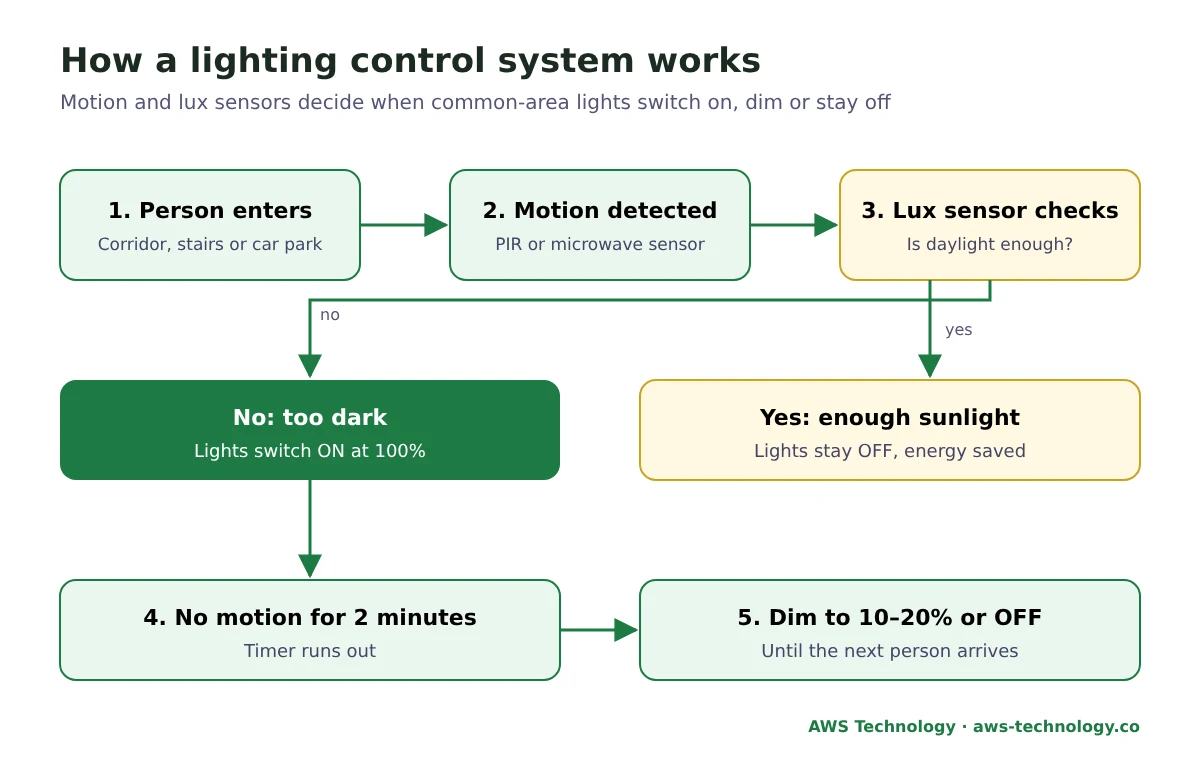
The settings are adjustable. Your facility management team can change time delays, dimming levels and schedules from a central panel or app, without rewiring.
Motion sensors vs. lux sensors: what each one does
Most common areas benefit from both, but they solve different problems.
Motion and occupancy sensors
These save energy when a space is empty. Three technologies are common:
| Sensor type | How it detects | Best for | Watch out for |
|---|---|---|---|
| PIR sensor (passive infrared) | Body heat moving across zones | Corridors, staircases, lobbies | Needs line of sight; less sensitive to very slow movement |
| Microwave sensor | Reflected radio waves | Car parks, long corridors, areas with obstacles | Can “see” through thin partitions, so range must be set carefully |
| Dual-technology | PIR and microwave together | Stairwells, open-plan areas, places where false triggers matter | Slightly higher cost |
In a study at a federal office building, occupancy sensors saved 20–26% of lighting energy compared with manual switching (Lawrence Berkeley National Laboratory). Common areas are usually emptier than offices, so savings there are often higher.
Lux sensors and daylight harvesting
Lux sensors save energy when the sun is doing the work. Dubai has strong sunshine most of the year, so lobbies with glass façades, podium walkways and stairwells with windows can often run with lights off or dimmed for much of the day. In the same Berkeley study, adding daylight dimming to occupancy sensing raised total savings to 46%. Learn more about daylight harvesting with lux sensors.
Without sensors vs. with sensors
| Item | Without a lighting control system | With motion and lux sensors |
|---|---|---|
| Operating hours | 24 hours a day, 7 days a week | Only when occupied and not bright enough |
| DEWA bill for common areas | Fixed, high | Lower; savings depend on occupancy and daylight |
| LED lifespan | Burns through rated hours faster | Fewer burning hours, so fittings last more calendar years |
| Maintenance | More lamp and driver replacements | Fewer replacements and callouts |
| Safety | Always lit | Lit on arrival; low-level background light can stay on |
| Green building goals | Harder to meet | Supports Al Sa’fat and Net Zero targets |
| Data | None | Usage and fault reports (with KNX, DALI or Lutron platforms) |
Where a lighting control system Dubai buildings use saves the most
Each common area has its own pattern of use, so a lighting control system Dubai engineers design is never one-size-fits-all. A good design matches the sensor, time delay and dimming level to that pattern.
Corridors and lift lobbies
Residential corridors are busy at certain hours and empty for long periods. PIR sensors every few metres switch lights on ahead of residents, then dim them to a low level after 1 to 3 minutes. Read more in our guide to motion sensor lighting for corridors and staircases.
Staircases and fire escapes
Stairwells are rarely used in towers with lifts, so they offer some of the largest savings. Dual-technology sensors on each landing avoid lights switching off while someone is still climbing. Lights can dim rather than switch off fully, so escape routes are never completely dark. Emergency lighting stays on its own separate circuit as required by Civil Defence rules.
Lobbies and reception areas
Ground-floor lobbies in Business Bay and Downtown towers often have large glass walls. Lux sensors keep general lighting off during bright hours, while time schedules dim feature lighting after midnight. Occupancy sensors handle back-of-house areas such as mail rooms and service corridors.
Basement and podium car parks
Car parks run long hours with low occupancy, which makes them ideal for zoned occupancy control. Microwave sensors cover long driving aisles, and fittings dim to 10–30% between cars instead of switching off. Our article on the parking lighting control system explains zoning and delay settings in detail.
Building perimeter and podium walkways
Outdoor and semi-open areas can use astronomical time clocks and lux sensors, so lights come on at dusk and switch off at sunrise automatically, even as sunset times change through the year.
Lighting control system Dubai examples by building type
The same principles apply everywhere, but the best set-up changes with the building.
Residential towers
In a typical tower in Dubai Marina, JVC or Business Bay, a lighting control system Dubai owners’ associations approve usually covers lift lobbies on every floor, staircases, the ground-floor lobby and the basement car park. Corridors dim to a low level at night, stairwells switch on per landing, and the car park dims between cars. Service charges benefit directly because common-area electricity is shared by all owners.
Villa compounds and community buildings
In villa communities, the focus moves to clubhouses, gyms, gatehouses and street lighting. Astronomical time clocks handle outdoor lights, while occupancy sensors control changing rooms and plant rooms that are empty most of the day.
Commercial and office buildings
Offices in Downtown, DIFC or Al Garhoud combine common-area sensors with daylight dimming near the façade and schedules that follow working hours. A KNX or DALI lighting control system Dubai facility managers can monitor from one screen also reports faulty fittings before tenants complain.
Warehouses and workplaces
High-bay areas and loading docks are often used in short bursts. Microwave sensors with high-low dimming keep aisles safe while cutting hours at full power, and lux sensors make use of roof lights where they exist. For any of these buildings, a well-planned lighting control system Dubai teams can adjust over time keeps delivering savings year after year.
KNX, DALI and Lutron: choosing the right platform
Sensors can work standalone, but most buildings get more value when their lighting control system Dubai design connects to a control platform.
- KNX lighting control Dubai projects use an open international standard with many manufacturers, including Zennio and MDT. KNX suits towers and villas where lighting, AC and blinds should work together.
- DALI lighting control gives each LED driver an address, so you can dim, group and monitor individual fittings and report lamp faults to facility management.
- Lutron offers dedicated lighting control systems with strong dimming quality, often chosen for premium lobbies and hospitality.
AWS Technology designs systems on all three and integrates products from Lutron, Zennio, MDT KNX, Bticino, Vimar and ThinKnx. The right choice depends on building size, existing wiring and whether you want central monitoring. See our smart lighting control services in Dubai.
Dubai regulations and green building goals
Energy-saving lighting UAE projects, and every new lighting control system Dubai developers specify, are increasingly driven by policy, not just cost.
- Al Sa’fat (Dubai Green Building System): Dubai Municipality’s rating system sets energy-efficiency requirements for new buildings, and lighting controls help projects meet its energy targets. Check the current edition on the Dubai Municipality building publications page and confirm requirements with your MEP consultant.
- UAE Net Zero 2050: the UAE’s national strategic initiative targets net-zero emissions by 2050. Cutting wasted lighting in existing buildings is one of the quickest steps owners can take.
- DEWA tariffs: DEWA bills electricity in slabs, so a building on a higher slab saves more per kWh it avoids. Check the latest rates on the DEWA slab tariff page.
Benefits for owners, developers and facility managers
- Lower DEWA bills: common-area lighting only runs when needed.
- Longer LED life: fewer burning hours means fittings and drivers last more years.
- Less maintenance: fewer replacements and callouts for the facility management team.
- Better safety and security: lights switch on as soon as someone enters, which also deters intruders in car parks.
- Higher building value: green credentials help with leasing, owners’ association approvals and future regulations.
- Clear data: smart building automation Dubai platforms report energy use and faults.
How to plan a lighting control upgrade
- Site survey: map every common area, its fittings, wiring and hours of use.
- Energy assessment: estimate current consumption and realistic savings for each zone.
- Design: choose sensors, zones, time delays and the control platform. We provide a 2D/3D design proposal before work starts.
- Approval: share the design with the owners’ association, MEP consultant or facility manager.
- Installation and commissioning: install, programme and test sensors zone by zone, usually without closing the building.
- Fine-tuning and support: adjust delays and lux levels after a few weeks of real use.
Choosing a lighting control system Dubai contractor: a short checklist
The right partner matters as much as the right sensor. Before you sign, ask each lighting control system Dubai contractor these questions:
- Do they survey first? A proper proposal starts with a site visit, a fitting count and a check of existing wiring and drivers.
- Can they show a design? Ask for a layout showing every sensor, its coverage and the zones it controls.
- Which platform do they recommend, and why? A good contractor explains when standalone sensors are enough and when KNX, DALI or Lutron is worth the extra cost.
- Who programs and supports the system? Time delays and lux levels need fine-tuning after handover, so local support in Dubai is essential.
- Will the design meet Civil Defence and Al Sa’fat requirements? Emergency lighting must stay independent, and green building documents should be ready for approval.
Common mistakes to avoid
Most complaints about sensor lighting come from poor design, not from the technology itself. Avoid these mistakes when you plan a lighting control system in Dubai:
- Too few sensors: long corridors and L-shaped lobbies need overlapping coverage, or lights switch off while people are still walking.
- Very short delays in busy areas: lights that switch off too quickly annoy residents and shorten driver life. Start with 2 to 5 minutes and adjust.
- Switching fully off where people feel unsafe: in car parks and stairwells, dimming to a low level often works better than full darkness.
- Ignoring daylight: a lux sensor in a sunlit lobby can save more than an occupancy sensor alone.
- No handover training: facility management teams need to know how to change settings without calling the installer.
A well-designed lighting control system Dubai residents barely notice is the best result: lights are always there when needed, and the DEWA bill quietly drops.
Why choose AWS Technology
- End-to-end service in Dubai: design, installation, programming and after-sales support from our Al Garhoud base, covering Dubai and the wider UAE.
- KNX and Lutron expertise: experience with open KNX systems and Lutron lighting control.
- Trusted brands: Lutron, Zennio, MDT KNX, Bticino, Vimar and ThinKnx.
- Design before execution: a 2D/3D design proposal so you see the layout and zones before any installation.
- Real projects: browse our smart home and building automation projects.
Frequently asked questions
Do motion sensors really save electricity?
Yes. Field studies by U.S. national laboratories found occupancy sensors cut lighting energy by about 20–26% in offices, and by much more in car parks with low occupancy. Savings in your building depend on how often each area is empty.
How long should corridor lights stay on after motion?
Most corridors work well with a delay of 1 to 5 minutes. Shorter delays save more energy; a U.S. DOE garage study found that cutting the delay from 10 to 2.5 minutes roughly halved LED energy use. Many buildings dim to a low level instead of switching fully off.
Can lux sensors work with LED lights?
Yes. LED fittings with dimmable drivers (0–10V, DALI or KNX) respond smoothly to lux sensors. Non-dimmable LEDs can still be switched on and off by daylight level.
How much does a lighting control system Dubai project cost?
Cost depends on the number of zones, sensors, the control platform and whether rewiring is needed. A small standalone corridor upgrade costs far less than a full KNX or DALI system for a tower. A site survey gives an accurate quotation.
Can sensors be added to an existing building?
Yes. Many sensors fit into existing ceiling openings or replace current switches, and wireless options reduce rewiring. Work is usually done floor by floor while the building stays open.
Will the lights switch off while someone is still in the stairwell?
Not if the system is designed well. Dual-technology sensors on each landing and a sensible time delay keep lights on while people move. A low background level can also stay on at all times.
Conclusion: is a lighting control system Dubai upgrade worth it?
For most towers, villa compounds and commercial buildings, the answer is yes. A lighting control system Dubai owners install in corridors, staircases, lobbies and car parks cuts wasted energy, lowers DEWA bills and extends LED life, while keeping every space safe. With strong local sunlight, adding lux sensors increases savings further.
Book a free site survey and energy-saving assessment with AWS Technology. Contact us here or call or WhatsApp +971 50 140 7753.